- Place
- Eagle Harbor
- County
- Clay County
- ZIP
- 32003
- Coordinates
- 30.0847° N / 81.7063° W
- Air
- inland
- Radius
- within 30 mi
Eagle Harbor Thermador repair: 1990s built-ins, aging
Independent Thermador repair in Eagle Harbor, Fleming Island FL 32003: built-in kitchens of the 1990s and 2000s failing together, long island duct runs, boards.
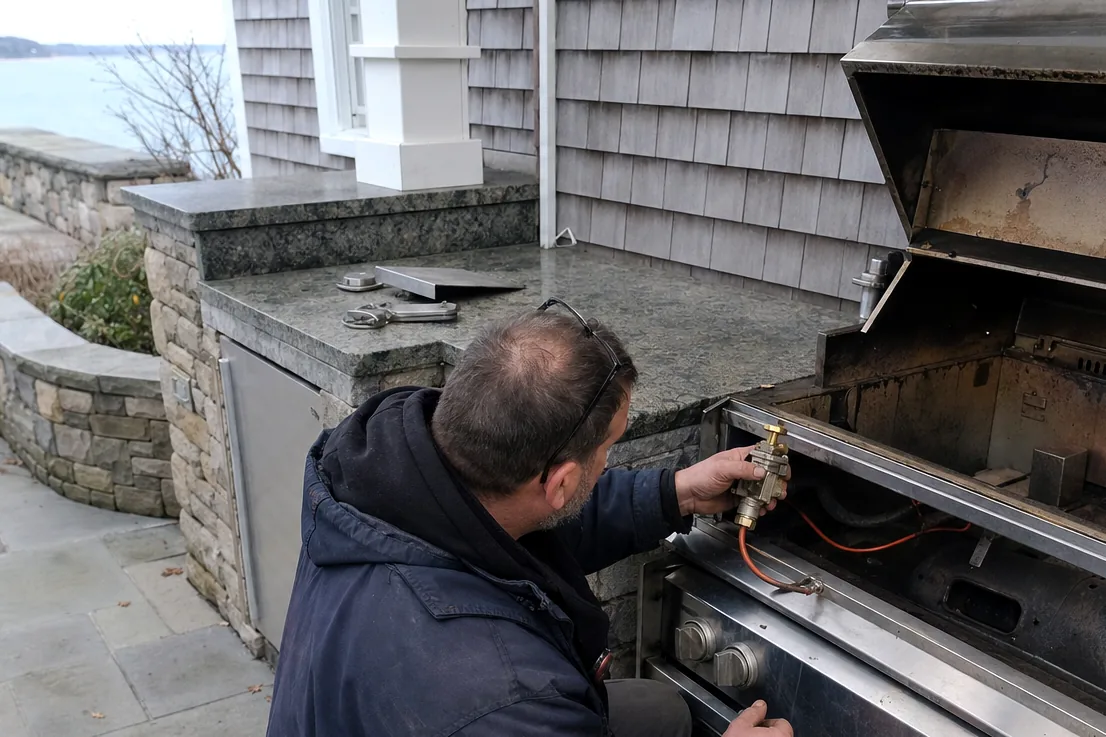
Eagle Harbor is the large master-planned community that occupies much of the middle of Fleming Island, in ZIP 32003, Clay County. It is a golf community built out in phases from the mid-1990s onward, and that phased build-out is the single most useful thing to know about servicing appliances in it.
A subdivision ages the way it was built
When a community goes up in phases, the kitchens go in in phases too. A street finished in 1998 got the appliance packages available in 1998. A street finished in 2006 got the 2006 packages. Twenty and thirty years later, those cohorts fail in cohorts.
That is why we regularly take three calls off the same street inside a month for what look like unrelated faults — a wall oven that died after a self-clean, a dishwasher that stopped draining, a refrigerator that lost its fresh-food side. They are unrelated in mechanism and entirely related in cause: everything in those kitchens has run roughly the same number of hours.
The practical consequence for an Eagle Harbor owner is that a repair decision is rarely just about the appliance in front of you. If the oven is twenty-two years old, the cooktop and the hood are twenty-two years old as well. We will tell you where a given unit sits on that curve, including when the honest answer is that the repair is not worth doing.
Parts, and the discontinued-platform problem
The oldest built-ins here are on platforms that have been out of production for years. Some parts for them are still available through OEM distribution, some are available only as a superseded replacement that needs a harness adapted, and some are genuinely gone.
We find that out before quoting, not after. The serial and model plate settles it — on a Thermador column it is usually inside the fresh-food compartment on an upper side wall; on a wall oven it is behind the door on the frame; on a dishwasher it is on the tub edge inside the door. Send us a photograph of that plate and we can tell you the parts position before anyone books a visit. On a kitchen of this vintage, that one photograph saves more money than anything else you can do.
Open-plan kitchens and the ventilation question
The kitchens in this part of Fleming Island were largely designed open to the family room, and a great many of them put the cooking surface on an island. That choice drives the ventilation: an island hood on a long duct run, or a telescoping downdraft going down through the slab or the floor system and out.
Downdrafts here fail in two ways. Mechanically, the lift mechanism collects twenty years of grease and grit and starts stalling partway up or refusing to retract, which is limit switches and track cleaning more often than it is a motor. Aerodynamically, they simply stop capturing, and the cause is almost never the blower — it is a duct run with more elbows than it should have, or a house that has been tightened up with new windows and no longer has anywhere to draw make-up air from.
If your hood “got weaker” without anything breaking, that second one is usually the story, and we will measure at the hood face before selling you a motor.
Storms, gates and getting to the door
Roughly 68 thunderstorm days a year make surge the leading cause of control-board failure across Clay County, and Eagle Harbor is no exception. The pattern to watch for is two appliances on one circuit going down in the same afternoon.
Access is the other thing worth settling before the day. Eagle Harbor kitchens routinely put the ovens and the refrigeration column at the far end of the house, and built-in equipment has to come out of its opening before much of it can be worked on. A column carrying a custom panel is heavy, it comes forward on its own feet or rails, and the clearance it needs is decided by the door casing, the threshold and whether the flooring was laid up to the appliance or under it.
We would rather know that route when the visit is booked than discover it in your kitchen. The same applies to gate codes and to any appliance with a plumbed connection — a steam oven, an ice maker, a dishwasher — where a serviceable shut-off within reach is not something we can assume. A technician sitting at a gate, or hunting for a valve, is time you are paying for.
Off this sheet: heating, air conditioning, heat pumps, air handlers and their ductwork. Doctors Lake Kitchen Co. repairs built-in Thermador kitchen appliances, and that is all we take on here.
Before the visit: photograph the model and serial plate and tell us the route the appliance would take out of the room. Both change what rides in the van, and both are cheaper to establish now than on the day.
What does a repair cost in Eagle Harbor?
The visit is $80. Beyond that, the honest answer is a band and not a number, because the same symptom has two or three candidate causes and they do not cost the same. The bands that fit this page are below. Parts and labour together, the work on this sheet lands between $200 and $1,050. The exact number is set down in writing once the fault has been read, and nothing is ordered until you have seen it.
| Repair | Parts and labour |
|---|---|
| Diagnostic visit, credited to the repair | $80 |
| Control board or touch panel | $440–$1,050 |
| Door hinge, glass or seal | $200–$660 |
| Convection fan or motor | $270–$730 |
What do people in Eagle Harbor ask first?
- Are Eagle Harbor kitchens all the same vintage?
- Close enough to matter. The neighbourhood went up in phases through the 1990s and 2000s, so built-ins fitted at construction reach the end of their electronics life within a few years of each other. One street can produce three unrelated calls in a season without anything being wrong with the brand.
- The island hood has a long duct run. Does that change the repair?
- It changes the diagnosis, not the price. A long run with several elbows costs real airflow, so a hood that has never captured well may have a duct problem rather than a blower fault. Airflow is measured at the hood face first, and the motor band is $270–$730 if the blower really is the answer.
- The house needs an air conditioner replaced. Is that you?
- No. Eagle Harbor houses reached the age where the air handler and the built-in kitchen wear out in the same decade, which is why we get asked. We repair the kitchen: refrigeration, cooktops, ovens, dishwashers, hoods and wine storage. Heating and cooling equipment is an HVAC contractor’s work, not ours.
- Can you get to Eagle Harbor the same week?
- Scheduling is booked by appointment rather than promised by window, and the honest answer comes on the phone rather than on a page. Scheduled appointments only. We do not run an overnight or emergency call-out service. Bring the model and serial plate to that call and the correct part often rides along on the first trip.
What owners in Eagle Harbor said afterwards
4.6 out of 5, across 73 customer reviews. Each one below is a single visit, in the words of the person who paid for it.
The door latch stayed locked after a self-clean even with the oven stone cold. He freed the latch motor and then replaced it. A second visit was needed for the part, which was the only frustrating part of a clear job.
Emmett K.
The door had started dropping open instead of staying where I left it. A cable had frayed through on one side. He replaced both cables and the springs together so the tension stayed even, which made sense to me.
Mirabel T.
The speed oven stopped heating on the fast side while the conventional side carried on as normal. He diagnosed it clearly and the repair holds, but the part sat on order for a fortnight and nobody told me until I asked.
Anneliese C.