- Topic
- diagnosis
- Appliance
- cooktops
- Filed
A Thermador induction zone that will not heat
How to work through a Thermador induction zone that reports no pan or refuses to heat, from cookware and cooling airflow down to the coil board itself.
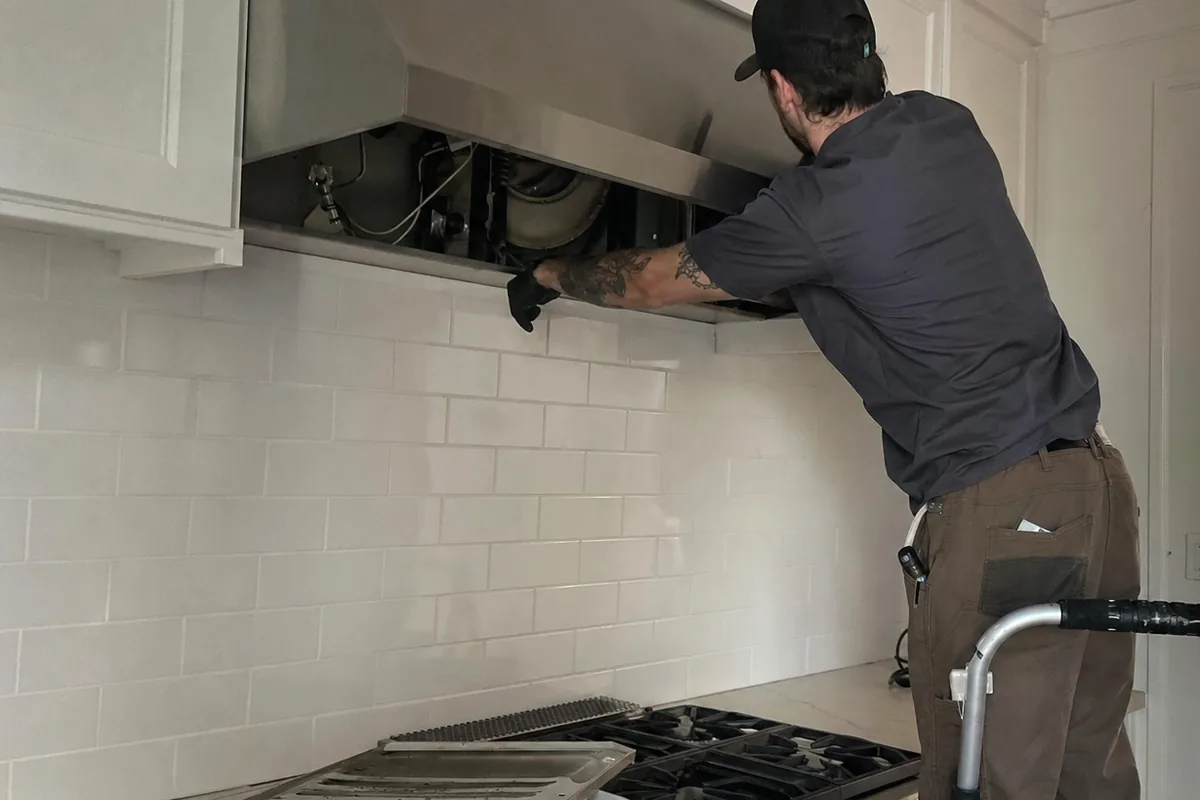
One zone dead and the rest of the surface working is the most common induction complaint we take, and it is worth knowing that it has a short list of causes. Most of them are checkable in the kitchen before anyone books a visit.
Start with the pan, because it is free
Induction heats by inducing current in the cookware. If the base is not ferromagnetic, nothing happens, and the cooktop will correctly report no pan.
Hold a household magnet against the base of the pan. If it does not stick firmly, that pan will never work on induction — no fault, no repair. Aluminium, copper and most fully austenitic stainless behave this way. Some clad pans have a magnet layer that only covers the centre of the base, which produces the odd symptom of a pan working on a small zone and not a large one.
The other cookware problem is flatness. A base that has warped away from the glass, even slightly, drops out of range. Set the pan on a flat countertop and look for rock. This matters more on high-power zones than on low ones.
Then check what the zone is being asked to do
Two things routinely look like a fault and are not.
Minimum pan diameter. Every zone has one. A small pot on a large zone can fall below detection. Move it to a smaller zone before assuming anything is broken.
Power sharing. Induction cooktops group zones onto shared power stages, and running several zones at high power can cause the surface to limit one of them. If the “dead” zone comes back when you turn the others down, that is designed behaviour, not a failure.
Then the cooling path, which is where most real faults live
Behind the glass, every induction zone is an inverter driving a coil, and the power devices in that inverter depend entirely on a fan to stay inside their temperature limits. Thermal problems are the single largest category of genuine induction failures.
The symptom is time-dependent: the zone works at first and drops out after a few minutes, or works at low power indefinitely and cuts out at high power. That shape — fine cold, fails hot — is thermal until proven otherwise.
Causes, in order of how often we find them:
- Blocked intake. An induction cooktop needs a clear air path underneath it. A drawer packed to the ceiling directly below the unit, or a cabinet back that was closed off during a renovation, will do this. It is the single most common installation-caused fault we see on retrofitted kitchens.
- A fan that has slowed. Bearings, or a fan full of the dust and pollen this region generates in spring.
- A genuinely failed thermistor, reporting a temperature the coil is not at.
Then the electrical supply
If a zone is dead from cold, and dead consistently, measure the supply before condemning anything. A full-width induction cooktop wants its own high-amperage circuit, and in older Fleming Island and Orange Park kitchens the cooktop position was frequently wired for something else entirely. A shared or undersized circuit produces brownouts under load, nuisance trips at boost, and intermittent faults that read as electronic and are not.
Then the coil board
Only now. Each zone or pair of zones has its own power board, and a failed board takes out that zone while leaving the interface and the other zones untouched. That is why “one zone dead” is so often a board — but it is also why it should never be the first guess, because three cheaper explanations sit in front of it.
In Clay County there is a specific reason boards fail: roughly 68 thunderstorm days a year, and a near-strike transient will kill a coil board while leaving the display lit. If two zones died in the same afternoon, or another appliance on the same circuit failed at the same time, that is the supply side talking. We measure the supply before we order a board, every time.
When it is over
A cracked or chipped glass surface ends the conversation. There is no repair for the glass, and running a cracked induction top puts liquid onto live electronics underneath it. We will tell you that on the phone rather than charge for a visit to say it in person.
What does this cost to put right?
The visit is $80. Beyond that, the honest answer is a band and not a number, because the same symptom has two or three candidate causes and they do not cost the same. The bands that fit this page are below. Parts and labour together, the work on this sheet lands between $200 and $1,050. The exact number is set down in writing once the fault has been read, and nothing is ordered until you have seen it.
| Repair | Parts and labour |
|---|---|
| Diagnostic visit, credited to the repair | $80 |
| Control board or touch panel | $440–$1,050 |
| Convection fan or motor | $270–$730 |
| Door hinge, glass or seal | $200–$660 |
What do people ask after reading this?
- Is it the cookware or the cooktop?
- Test it before anything else: a magnet that grips the base firmly means the pan can be driven, and a pan smaller than the zone or with a warped base may not be detected at all. A pan that works on the other three zones and not on this one points at the appliance, and that is the moment to call.
- Why does the cooling path matter on an induction surface?
- Because the electronics live directly under the glass with very little air. A choked intake, a cabinet cutout that was never opened to specification, or a tired fan will push a zone into thermal shutdown that looks exactly like a failure. The fan band is $270–$730.
- If it is the coil board, does the whole surface get replaced?
- No. Coil boards are replaced individually, which is why a dead zone lands at $440–$1,050 rather than at the price of a new cooktop. Replacing a whole surface for one zone is the expensive candidate, and it is rarely the right one.