- Topic
- parts
- Filed
Model plates, OEM parts and lead times
Where to find the data plate on a Thermador appliance, why the model and serial decide the repair, and what OEM sourcing means for cost and lead time.
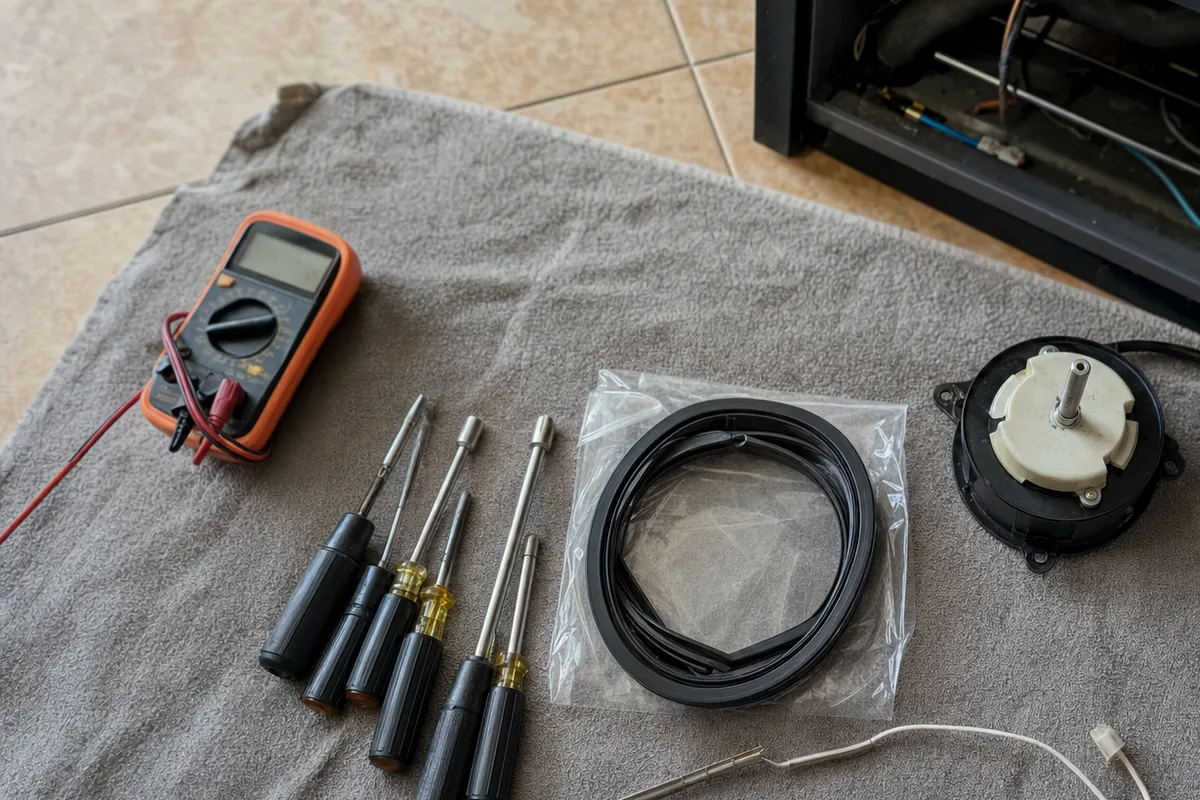
The most useful thing you can do before booking any appliance repair is photograph the data plate. It costs nothing, it takes a minute, and on an appliance more than ten years old it routinely changes the entire shape of the conversation.
Where the plate is
It is never on the front, because nobody wants to look at it. On a Thermador appliance, look here:
- Column and built-in refrigeration — inside the fresh food compartment, usually on an upper side wall or on the ceiling of the cabinet near the front.
- Wall ovens — open the door and look at the frame, most often along one side or across the bottom of the opening.
- Dishwashers — on the tub edge inside the door, visible with the door open.
- Cooktops and rangetops — underneath. On a cooktop that generally means from the cabinet below, which is why this is the one people photograph least and the one where it matters most.
- Hoods — inside, behind the filters.
- Wine columns — inside the cabinet, usually on a side wall near the top.
Photograph the whole plate, not the number you think matters. The model number, the full serial, and any index or revision code all get used.
Why the serial decides things the model does not
Manufacturers revise appliances continuously without changing the model number. A control board fitted in the first production year may be a different part from the one fitted three years later in an identically labelled appliance, with a different connector or different firmware.
The serial is what resolves that. It is also what tells us the build date, which determines whether a part is current, superseded, or discontinued.
Superseded is the interesting middle case. It means the original part is gone but a replacement exists, sometimes needing a harness adapter or a different mounting bracket. That is a perfectly good repair. It is also more labour than a like-for-like swap, and you should be told that before the work starts, not after.
Why we use OEM parts
Aftermarket parts exist for most of what we replace, and they are cheaper. We do not use them, for reasons that are practical rather than ideological.
Control electronics are the clearest case: an aftermarket board may work, or may work until the appliance asks it to do something specific, and diagnosing a second-source board that behaves almost correctly is genuinely harder than diagnosing a failed original. Sealed-system components and thermistors matter for the same reason — a probe with a slightly different resistance curve will drive the control to the wrong conclusion with complete confidence.
Genuine OEM parts also carry our full parts warranty. That commitment is only honest if we know what we fitted.
The trade-off is real and we will state it plainly: OEM costs more, and on occasion it takes longer to arrive. On an appliance built to last twenty years, that is the right trade. On a twenty-two-year-old unit whose board is discontinued, it may not be, and we would rather tell you that than sell you a repair that leaves you worse off.
Lead times, honestly
Common wear parts — filters, gaskets, spray arms, igniters, fan motors, hinges — are usually available quickly. Control boards for current models are usually available. Control boards for discontinued platforms are the ones that stretch, and cosmetic and structural parts for older units are the ones most likely to be gone entirely.
We check availability before quoting. A written estimate that assumes a part exists is not an estimate, and an appointment booked around a part that will never arrive wastes your week rather than ours.
What this means for older kitchens
A lot of Fleming Island was built out between the mid-1990s and the late 2000s, which puts a large number of original built-in appliances at fifteen to thirty years old. Whole streets reach the discontinued-parts threshold at roughly the same time.
If your kitchen is in that band, send the plate photographs before anything else. We can tell you the parts position for your specific serial before a technician is dispatched, and on an appliance of that age that single message is worth more than any advice we could give you over the phone.
What does this cost to put right?
The visit is $80. Beyond that, the honest answer is a band and not a number, because the same symptom has two or three candidate causes and they do not cost the same. The bands that fit this page are below. Parts and labour together, the work on this sheet lands between $440 and $2,360. The exact number is set down in writing once the fault has been read, and nothing is ordered until you have seen it.
| Repair | Parts and labour |
|---|---|
| Diagnostic visit, credited to the repair | $80 |
| Refrigeration column sealed system | $900–$2,360 |
| Control board or touch panel | $440–$1,050 |
What do people ask after reading this?
- Where is the data plate on a built-in?
- Behind or under the door on most of them: the frame of a refrigeration column, the left jamb of a wall oven, the tub edge of a dishwasher, the underside of a cooktop frame. Photograph the whole plate rather than typing the number out — the serial and the revision matter as much as the model.
- Can you still get parts for a twenty-year-old appliance?
- Often, but not always, and the plate settles it. Some parts for out-of-production platforms are still in OEM distribution, some exist only as a superseded version that needs the harness adapted, and some are genuinely gone. That is checked before anybody pays for a visit.
- Why does a written estimate separate parts from labour?
- A written estimate comes before any part is ordered or any repair begins. Nothing proceeds without your approval. Splitting the two lets you see which half of the number you are paying, and it is the only way to judge a band like $440–$1,050 against the alternative. The estimate holds for thirty days.