- Appliance
- ventilation
- Diagnostic
- $80
- Labor warranty
- 90 days
- Parts warranty
- 365 days
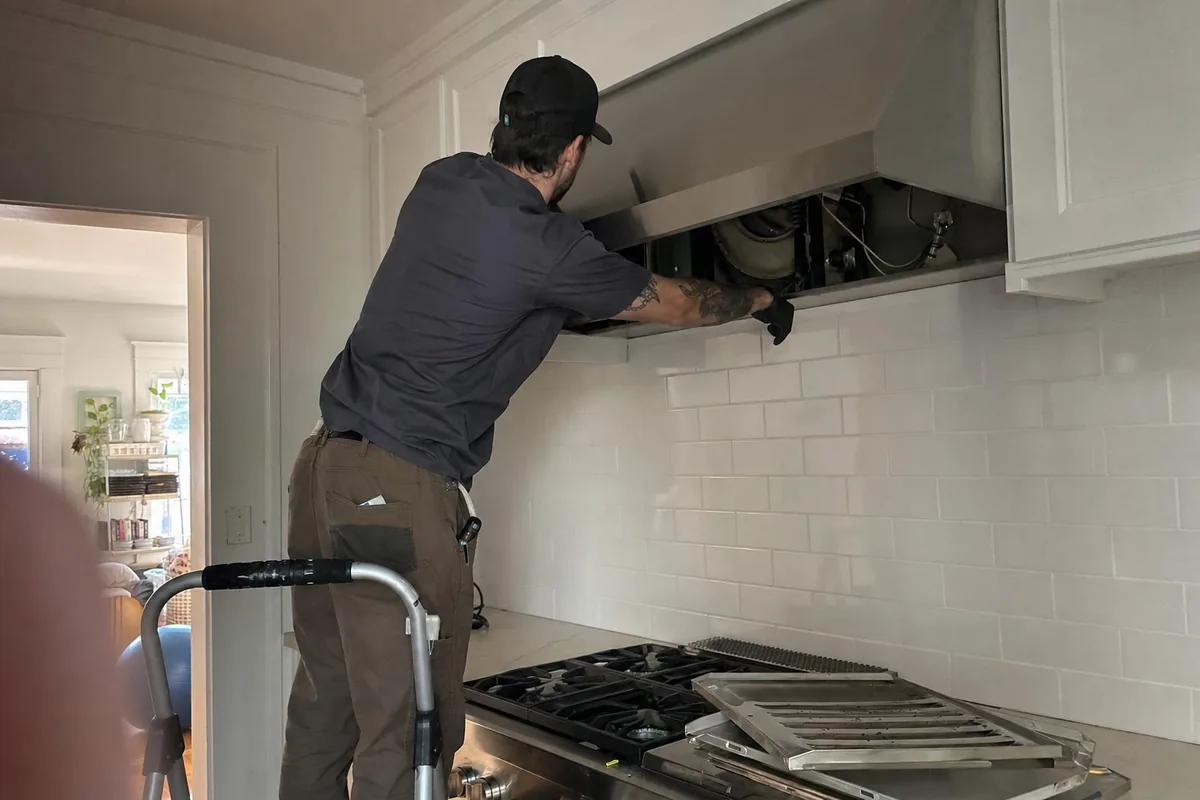
Thermador hood stuck at one speed, downdraft halfway up
Independent Thermador range hood, downdraft and remote blower repair in Fleming Island FL: one-speed blowers, stalled downdrafts, dead lighting, lost capture.
Symptoms we see
- Blower running at one speed regardless of the setting
- Downdraft rising partway and stopping, or refusing to retract
- Hood lighting flickering or dead across the whole bar
- Loud rattle or drone that was not there last year
- Smoke rolling out at the front edge of the hood
- Backdraft damper audibly slapping in wind
Ventilation is the part of a Thermador kitchen most likely to be underperforming without anyone calling it broken. A hood that has lost a third of its airflow still makes noise, still lights the cooktop, and still feels like it is working — until the smoke starts rolling forward off the front edge.
Blowers: internal, in-line and remote
Thermador ventilation is sold as a hood or downdraft body plus a blower, and the blower may live inside the hood, in the duct run, or on the roof. Which one you have changes the repair completely.
An internal blower is the easiest to diagnose and the most likely to be caked in grease, because it sits directly in the airstream. A remote or roof-mounted blower is quieter in the kitchen and considerably more exposed to weather — in this climate that means a motor that has been through fifteen summers of humidity and an enclosure that may have taken standing water. When a remote blower fails here, we go up and look rather than replacing the switch inside first.
A blower stuck on one speed is a control fault, not a motor fault. Either the speed control board has failed, or the wiring between the hood control and the blower has lost a conductor. A blower that has gone loud is a bearing or an unbalanced wheel — often a wheel that has been cleaned unevenly, leaving grease on one side and bare metal on the other.
Downdrafts have a mechanical life of their own
A telescoping downdraft adds a lift mechanism to everything above: a motor, a drive, limit switches at the top and bottom of travel, and a control that expects to see those switches in a specific order. A downdraft that rises partway and stops has usually lost a limit switch, jumped a drive, or is binding on a track that has taken debris.
They also have a duct problem that hoods do not. A downdraft pulls air across the cooktop rather than letting it rise, and it does it through a duct run that generally goes down through the floor and out — a longer, more turbulent path with more elbows. Every elbow costs airflow. When a downdraft is not capturing, the duct run is as likely to be the answer as the blower.
Airflow, make-up air and Florida construction
Houses built on this side of Doctors Lake in the last thirty years are tight. That is good for the power bill and awkward for ventilation, because a blower that wants to move a large volume of air out of the kitchen has to get that air from somewhere. In a tight house, it will take it from wherever it can — down a water heater flue, past a dryer vent, or simply not at all, at which point the blower spins hard and moves very little.
This is why “my hood got weaker” is sometimes not about the hood. New windows, new weatherstripping, or a replaced door can quietly reduce a hood’s real-world capture without a single appliance component failing. We measure at the hood face before we sell a motor.
Make-up air is electrician and HVAC territory rather than appliance repair, and we will say so rather than sell you something adjacent to the actual fix.
So that the line is unmistakable: what we repair here is the hood, the downdraft and the blower that belong to the cooktop — kitchen appliances, fitted into kitchen cabinetry. We do not service heating systems, air conditioners, heat pumps, air handlers, or the ducts that carry conditioned air around the house. The duct above a hood is ours to measure and diagnose. A supply or return duct is somebody else’s trade, and on that one we will give you the name of a trade and nothing more.
Filters, dampers and lighting
Baffle filters want washing far more often than most people do it, and a loaded filter is the single cheapest airflow recovery available. Mesh filters that have been run through a dishwasher repeatedly go soft and stop sealing at the edges — worth checking if the hood is passing grease into the duct.
Backdraft dampers slap in wind. On an exposed site — the Doctors Lake frontage and the river side of the island in particular — a damper that has lost its counterweight or its gasket will announce itself all night. It is a small part and a fast repair.
Lighting has largely moved to LED assemblies rather than replaceable lamps, which means a dead light is a module or a driver, not a bulb. Worth knowing before you spend an afternoon looking for a bulb that does not exist.
Flat-rate diagnostic credited toward the repair, written estimate first, genuine OEM parts.
What does ventilation repair cost here?
The visit is $80. Beyond that, the honest answer is a band and not a number, because the same symptom has two or three candidate causes and they do not cost the same. The bands that fit this page are below. Parts and labour together, the work on this sheet lands between $270 and $1,050. The exact number is set down in writing once the fault has been read, and nothing is ordered until you have seen it.
| Repair | Parts and labour |
|---|---|
| Diagnostic visit, credited to the repair | $80 |
| Control board or touch panel | $440–$1,050 |
| Convection fan or motor | $270–$730 |
What do owners ask before booking ventilation work?
- The hood runs at one speed whatever the panel says. What fails there?
- Usually the speed control module rather than the motor itself. A motor that has failed does not run; a motor stuck at one speed is being told to. Separating the two before ordering is what keeps this off the motor band, which is $270–$730, and onto the control band at $440–$1,050.
- The hood stopped capturing smoke, but nothing has broken. How?
- A house can get tighter without the hood changing at all. New windows, new weatherstripping or a replaced door reduce the air available to replace what the blower throws out, and capture falls. Airflow is measured at the hood face before a motor is sold, because the fix there is not an appliance part.
- Something slaps in the hood when it is windy. Is that the blower?
- Almost never. It is the backdraft damper, and on exposed ground along the Doctors Lake and river frontage a damper that has lost its counterweight or its gasket will announce itself all night. It is a small part and a short visit, and the $80 diagnostic usually settles it in one.
What owners said about ventilation
4.6 out of 5, across 73 customer reviews. Each one below is a single visit, in the words of the person who paid for it.
Smoke kept rolling out at the front lip of the hood. He measured the airflow and was honest about the make-up air problem in our tight kitchen, then cleaned the baffles and got a real improvement without pushing a new hood.
Beatrix Y.
The hood was pulling far less than it used to with nothing obviously broken on it. He measured at the face, found the run partly blocked where it turns in the wall, and was honest that clearing that is work for another trade.
Odilia V.
The whole light bar went out at once, which had me buying bulbs I did not need. It was the driver behind the fascia. He replaced it and the light is even across the run again, which it had not really been for a while.
Cressida N.