- Appliance
- refrigeration
- Diagnostic
- $80
- Labor warranty
- 90 days
- Parts warranty
- 365 days
Thermador refrigerator warm on one side, Fleming Island
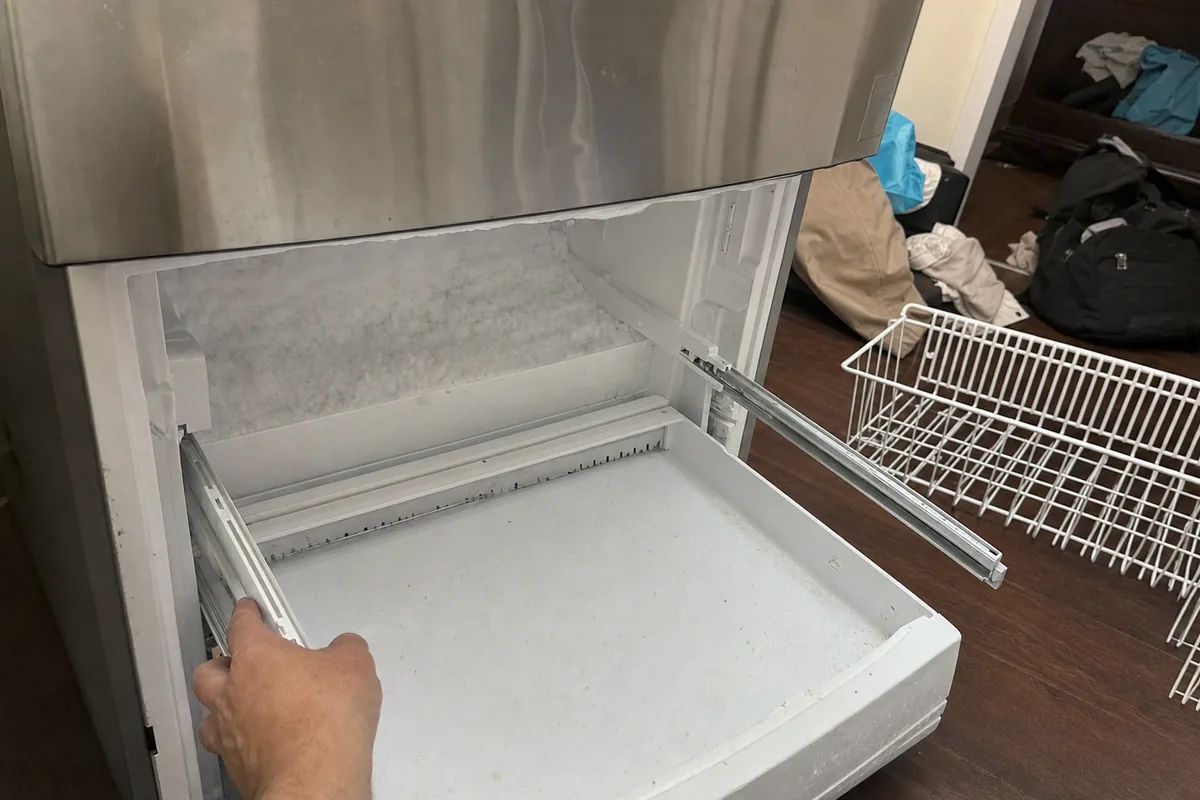
Independent Thermador built-in and column refrigeration repair in Fleming Island FL: a warm fresh-food side, an iced evaporator, a dead ice maker, a dark panel.
Symptoms we see
- Fresh food compartment drifting warm while the freezer holds temperature
- Ice maker filling but never releasing a harvest
- Evaporator fan audible, then silent, cycling on its own schedule
- Condensation standing along the door gasket or the mullion
- Compressor running continuously without reaching setpoint
- Display dark or unresponsive after a storm
- Refrigerator not cooling at all, with the compressor silent
A built-in column that drifts warm on one side is almost never a refrigerant problem first. It is usually air. Thermador columns and bottom-freezer built-ins move cold from a single evaporator through a duct system, and every failure that looks like “it stopped cooling” has to be sorted into one of four buckets before anyone reaches for a gauge set.
The order we work in
Airflow. An evaporator fan that has slowed, seized, or lost its speed signal starves the fresh-food duct while the freezer stays cold, because the freezer is sitting next to the coil. That single pattern — warm above, frozen below — accounts for a large share of the calls we take on refrigeration.
Defrost. If the defrost cycle is not terminating, the evaporator ices over and the same starved-duct symptom appears, except it comes and goes on a rhythm. A unit that recovers for six hours after the doors have been left open and then fails again is telling you it is defrosting by accident.
Controls. Column refrigeration runs on a low-voltage control system with a user interface, a main board, and in most cases an inverter driving a variable-speed compressor. Any of those can fail on its own, and in Clay County they frequently fail together because a storm transient took the whole low-voltage side out at once.
Sealed system. Only after the first three are cleared. Opening a sealed system that did not need opening is the most expensive mistake available in this trade. When it genuinely is the sealed system — a restriction, a leak at a process tube, a failed compressor — that work is performed by technicians holding EPA Section 608 certification, which is a credential we genuinely hold and one of the few that is legitimate to state.
Columns are cabinetry as much as appliance
Thermador sells refrigeration as separate columns in a range of widths, designed to sit flush with the surrounding cabinetry behind a custom panel. That changes what a repair looks like. A door that no longer seals is often not a gasket problem at all: it is a hinge carrying a heavy custom panel that has sagged a few millimetres, or a cabinet that has moved with the house. We measure the gasket crush and the door reveal before we sell anyone a gasket, because a new gasket on a sagging door fails again in a season.
The same logic applies to any conversation about replacement. If a column has to come out, the opening height, the required top clearance and the panel weight all have to be checked against what is available now. Openings framed for one generation of equipment do not always accept the next.
Ice makers, and how they actually fail
An ice maker is the first place a column shows trouble, because it depends on everything else in the cabinet being right. A unit that has quietly lost airflow across its evaporator makes less ice long before the fresh-food temperature moves far enough for anyone to notice, which is why “we are not getting much ice” is a refrigeration complaint before it is an ice-maker complaint.
When the ice maker itself is at fault, it is usually one of four things, and they present differently enough to separate before anything is opened. No water reaching the mold at all points at the supply, the shut-off or the fill valve. A full mold that never releases points at the mold heater or the harvest motor. Ice that is produced and then thrown away points at the level sensing or at a bin that is not seated where the sensing expects it. Hollow or undersized cubes point back at fill volume and at the temperature the mold is actually reaching.
We establish which of those is happening, and confirm the water supply is doing what it should, before any part is quoted.
What the visit includes
A flat-rate diagnostic, credited in full toward the repair if you go ahead. A written estimate before any part is ordered. Genuine OEM parts, and the standard labor and parts warranty on everything we complete. If the honest answer is that the unit is not worth the repair, that is the answer you get.
What does built-in refrigeration repair cost here?
The visit is $80. Beyond that, the honest answer is a band and not a number, because the same symptom has two or three candidate causes and they do not cost the same. The bands that fit this page are below. Parts and labour together, the work on this sheet lands between $440 and $2,360. The exact number is set down in writing once the fault has been read, and nothing is ordered until you have seen it.
| Repair | Parts and labour |
|---|---|
| Diagnostic visit, credited to the repair | $80 |
| Refrigeration column sealed system | $900–$2,360 |
| Control board or touch panel | $440–$1,050 |
What do owners ask before booking built-in refrigeration work?
- Why is the fresh food side warm while the freezer stays cold?
- Because a column and most built-ins make cold in one place and duct it to two. The freezer sits next to the evaporator and keeps its temperature while a stalled damper, a tired evaporator fan or a frosted coil starves the fresh-food duct. Those three are separated by measurement, not by guesswork, and the fan sits at $270–$730.
- Is a sealed-system repair worth paying for on an older column?
- A sealed system is the widest band on this sheet at $900–$2,360, and a replacement column, appliance only, is $4,200–$14,500. That comparison is the whole decision. A cabinet that is otherwise sound usually earns the repair; one already losing door seals, fans and a board in the same year usually does not.
- The display went dark after a storm — is the whole board gone?
- Not always. With roughly 68 thunderstorm days a year here, a near-strike transient kills low-voltage sections first, and a dark display can be a failed supply rail rather than a dead board. The supply is measured under load before anything is condemned. A board or touch panel runs $440–$1,050.
- The refrigerator is not cooling at all. What does that usually lead to?
- Nothing cold anywhere, rather than one side warm, points at the compressor, the inverter driving it, or the low-voltage supply that commands both. Those are measured before anything is opened, because a sealed system is $900–$2,360 while a board that has simply stopped commanding it is $440–$1,050.
What owners said about built-in refrigeration
4.6 out of 5, across 73 customer reviews. Each one below is a single visit, in the words of the person who paid for it.
Our column chirped its temperature alarm most nights and read perfectly fine by morning. He found the probe hanging loose off its clip against the liner, secured it, and logged a full day before he would call it fixed.
Perpetua K.
A tick from behind the vents turned into silence, and then the fresh side climbed. The evaporator fan blade had cracked at the hub. He carried the fan, fitted it, and the noise and the warmth went away together.
Georgina T.
The door had dropped far enough to catch on the panel below it. He replaced the worn hinge cartridge rather than shimming it, set the door square again, and checked the seal pulled down all the way round.
Sorrel M.