- Topic
- installation
- Appliance
- ventilation
- Filed
Hood airflow, make-up air, and whose trade it is
Why a range hood in a tight north Florida house can lose real capture without a single part failing, and how to tell a duct problem from a blower fault.
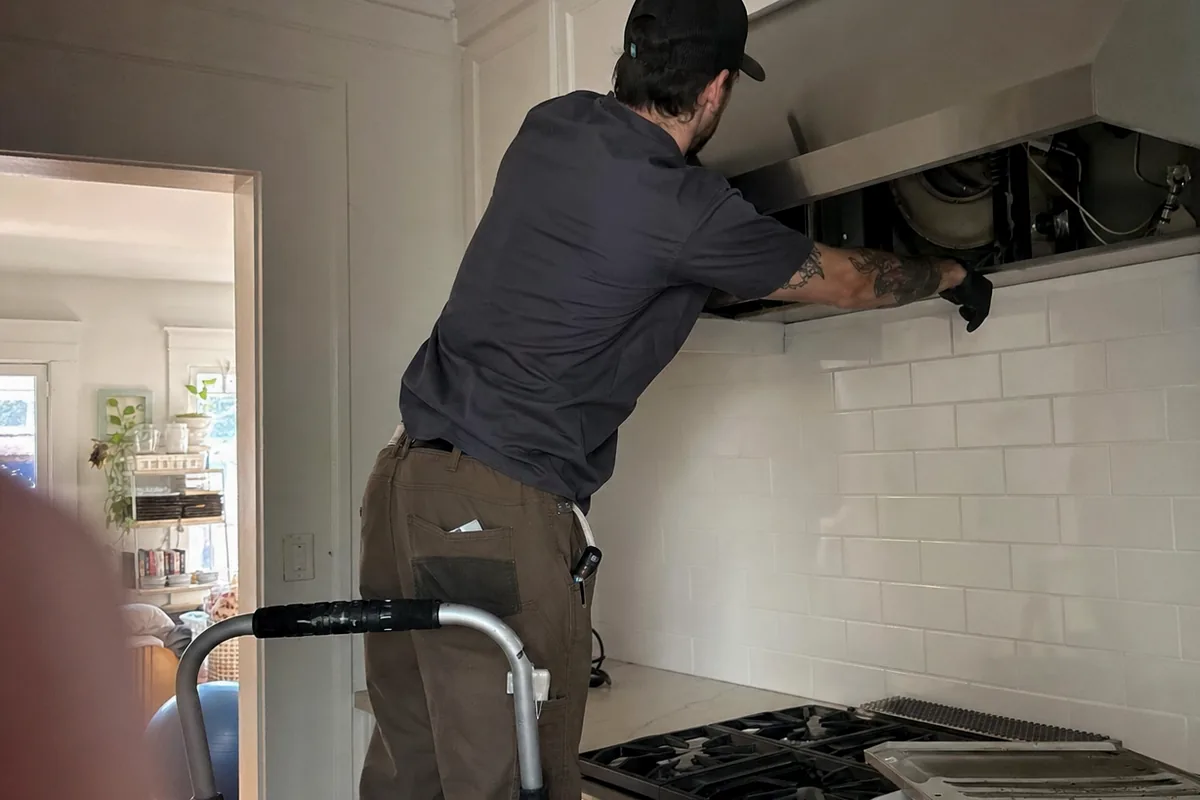
A hood that has lost a third of its real airflow still makes noise, still lights the cooktop, and still feels like it is working. The first honest signal is smoke rolling forward off the front edge, and by then people have usually decided the blower is failing. It frequently is not.
A blower does not move air, it moves a pressure difference
The number printed on the box is measured at zero static pressure. In a real house the blower has to overcome the duct run, the transitions, the backdraft damper, the roof or wall cap, and — the part almost nobody accounts for — the resistance of getting replacement air into the house at all.
That last one is why a hood can get weaker with nothing broken. If you replaced the windows, added weatherstripping, sealed the attic, or fitted a new exterior door, you tightened the envelope. The blower still spins at the same speed. It just moves less air, because the air it is trying to exhaust has nowhere to come from.
Houses built on Fleming Island in the last thirty years are tight by construction. Houses that have since been improved for energy are tighter. That is good for the power bill and awkward for a high-capacity hood.
How to tell make-up air from a blower fault
Two field tests, neither of which needs an appliance technician.
The door test. Run the hood at maximum with the house closed up. Crack an exterior door or window near the kitchen. If the hood audibly changes note and the capture visibly improves, you have a make-up air limitation, not an appliance fault. Nothing inside the hood will fix it.
The tissue test at the filters. With the hood on high, hold a light tissue against the filter face across the whole opening. Even, firm pull across all of it means the system is moving air. Strong at one end and weak at the other points at a loaded filter, a partly closed damper, or a transition immediately above the hood that is choking one side.
Duct runs, and why downdrafts are harder
Every elbow costs airflow. Flexible duct costs considerably more than smooth metal for the same length, and a section of flex that has been compressed to fit a joist bay can cost more than the rest of the run combined.
Downdrafts start at a disadvantage: they pull air sideways across the cooktop rather than letting it rise, and they usually do it through a longer, more turbulent path down through the floor system and out. When a downdraft is not capturing, we look at the duct before the blower nearly every time.
Backdraft dampers are the other quiet loss. A damper stuck partly closed by grease, or one that has lost its counterweight, will throttle the whole system. On a windy day near Doctors Lake a loose damper will also slap all night, which is at least a symptom that announces itself.
What is actually a blower fault
- Stuck at one speed regardless of the setting. That is the speed control board or the wiring between the hood control and the blower, not the motor.
- A drone or rattle that was not there last year. Bearings, or a wheel that has been cleaned unevenly and is now out of balance.
- Nothing at all. Check the blower’s own supply first — remote and in-line blowers are frequently on their own circuit, and that circuit is frequently in a place nobody remembers.
Remote and roof-mounted blowers deserve a note of their own here. They are quieter in the kitchen and considerably more exposed to weather, and after fifteen north Florida summers the enclosure may have taken standing water. When a remote blower fails on this coast, we go up and look rather than replacing the switch inside first.
The line we will not cross
Make-up air is HVAC and electrical work, and this company is not an HVAC contractor. Sizing a passive inlet or a powered make-up air unit, and interlocking it with the hood, is not appliance repair and we do not pretend otherwise — any more than we would take on a heat pump, an air handler or the ducted system that conditions the rest of the house. What we will do is measure at the hood face, tell you whether the loss is in the appliance, the duct or the house, and hand you an honest answer about which trade you actually need.
Filters, though, are yours and they are free. Baffle filters want washing far more often than most people do it, and a loaded filter is the cheapest airflow you will ever recover.
What does this cost to put right?
The visit is $80. Beyond that, the honest answer is a band and not a number, because the same symptom has two or three candidate causes and they do not cost the same. The bands that fit this page are below. Parts and labour together, the work on this sheet lands between $270 and $1,050. The exact number is set down in writing once the fault has been read, and nothing is ordered until you have seen it.
| Repair | Parts and labour |
|---|---|
| Diagnostic visit, credited to the repair | $80 |
| Control board or touch panel | $440–$1,050 |
| Convection fan or motor | $270–$730 |
What do people ask after reading this?
- Do you install make-up air systems?
- No, and we are not an HVAC contractor in any other sense either. Sizing a passive inlet or a powered make-up air unit and interlocking it with the hood is mechanical and electrical work, not appliance repair. What we do is measure at the hood face and tell you honestly whether the loss is in the appliance, the duct or the house.
- How do you tell a duct problem from a blower fault?
- By measuring rather than by listening. A blower that has lost capacity is slower and quieter; a duct that is fighting it runs the blower hard and moves very little. The reading at the hood face separates the two before anybody sells a motor at $270–$730.
- Are filters worth cleaning, or is that just maintenance advice?
- They are the cheapest airflow you will ever recover, and they are free. Baffle filters want washing far more often than most people do it, and mesh filters run repeatedly through a dishwasher go soft and stop sealing at the edges.